
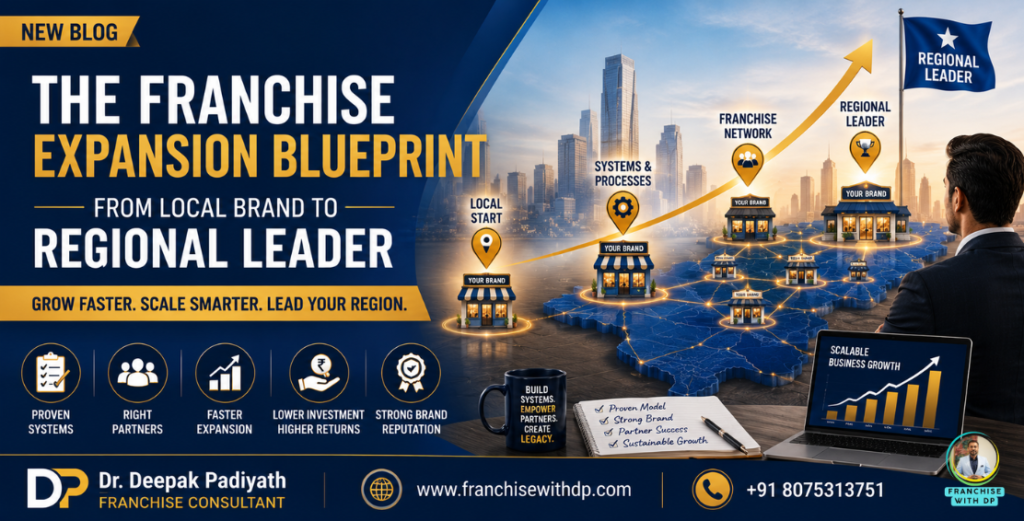
Many successful businesses reach a stage where the owner begins asking:
“How do I grow beyond my current location?”
Opening additional company-owned branches is one option. But it often comes with significant challenges:
- Large capital investment
- Recruitment and management complexity
- Operational control issues
- Slower expansion
This is exactly why many growing businesses are turning to franchising as their preferred expansion strategy.
Franchising allows businesses to expand using the investment, local market knowledge, and entrepreneurial energy of franchise partners while maintaining brand standards and operational systems.
The right franchise strategy can transform a respected local business into a recognized regional brand.
Step 1: Build a Business That Can Be Replicated
The first question is not:
“Can I franchise my business?”
The better question is:
“Can someone else successfully operate my business using a proven system?”
A franchiseable business must have:
- Consistent customer experience
- Proven profitability
- Documented processes
- Repeatable operations
- Strong brand identity
If the business depends entirely on the owner’s personal involvement, it may need further systemisation before franchising.
Example:
A restaurant that succeeds because of the owner’s daily supervision is difficult to franchise.
A restaurant with standardized recipes, procurement systems, training manuals, and quality controls is far easier to replicate.
Step 2: Document Everything
Successful franchises run on systems, not individuals.
This means documenting:
- Operating procedures
- Customer service standards
- Recruitment processes
- Vendor management
- Marketing activities
- Financial reporting systems
These Standard Operating Procedures (SOPs) become the foundation of franchise consistency.
Remember:
Franchisees don’t buy your current outlet. They buy your system.
Step 3: Create a Strong Franchise Model
Every franchise requires clarity on:
- Franchise fee
- Royalty structure
- Territory rights
- Investment requirements
- Training support
- Marketing contributions
An attractive and sustainable franchise model creates value for both the franchisor and the franchisee.
The objective is not simply selling franchises.
The objective is building successful franchise partners.
Step 4: Pilot Before Scaling
Many businesses rush into franchising after the success of their first outlet.
This can be risky.
Testing systems across multiple locations helps identify:
- Operational gaps
- Training needs
- Supply chain issues
- Market differences
A proven multi-location model gives future franchisees greater confidence.
Step 5: Recruit Franchise Partners Carefully
One of the biggest reasons franchise systems fail is poor franchisee selection.
The best franchise partner is not always the person with the most money.
Look for:
- Commitment
- Business mindset
- Alignment with company values
- Ability to manage teams
- Long-term vision
The right franchisees become ambassadors for your brand.
Step 6: Support Drives Growth
The relationship does not end after signing the agreement.
Strong franchisors provide:
- Initial training
- Ongoing support
- Marketing guidance
- Performance monitoring
- Operational assistance
The success of franchisees directly influences the reputation and growth of the brand.
When franchisees grow, the franchisor grows.
The Financial Advantage of Franchising
Traditional expansion requires the company to invest heavily in:
- Infrastructure
- Staffing
- Inventory
- Marketing
Franchising changes this equation.
The franchise partner invests in setting up the outlet while the business owner focuses on:
- Brand development
- Systems
- Training
- Support
This allows faster expansion with lower capital requirements.
From Local Success to Regional Leadership
Many of today’s leading brands started as a single successful outlet.
Their growth came not from opening dozens of company-owned branches but by creating systems that others could replicate successfully.
The businesses that dominate regional markets are often those that learned to scale through people, processes, and partnerships.
Franchising provides exactly that framework.
Conclusion
Franchising is not simply a growth strategy.
It is a business transformation strategy.
It shifts the business from being owner-dependent to system-dependent.
For businesses with a proven model, strong customer demand, and scalable operations, franchising can become the fastest route from local success to regional leadership.
The question is no longer:
“Can I open another branch?”
The better question is:
“Can I build a network of successful entrepreneurs carrying my brand forward?”
About the Author
Dr. Deepak Padiyath is a Franchise Consultant who helps businesses expand through franchising and assists investors in identifying suitable franchise opportunities.
Whether you are operating a single successful outlet or planning regional expansion, strategic franchise planning can significantly accelerate growth.
🌐 Website: Franchise With DP
📞 Contact: +91 8075313751