From a Successful Business to a Successful Franchise
Many business owners have built a successful outlet through years of hard work, personal relationships and hands-on supervision.
Then comes the next question:
“Can I replicate this success through franchising?”
The answer depends on something more than your sales or brand popularity.
It depends on whether your business can work successfully without you being there every day.
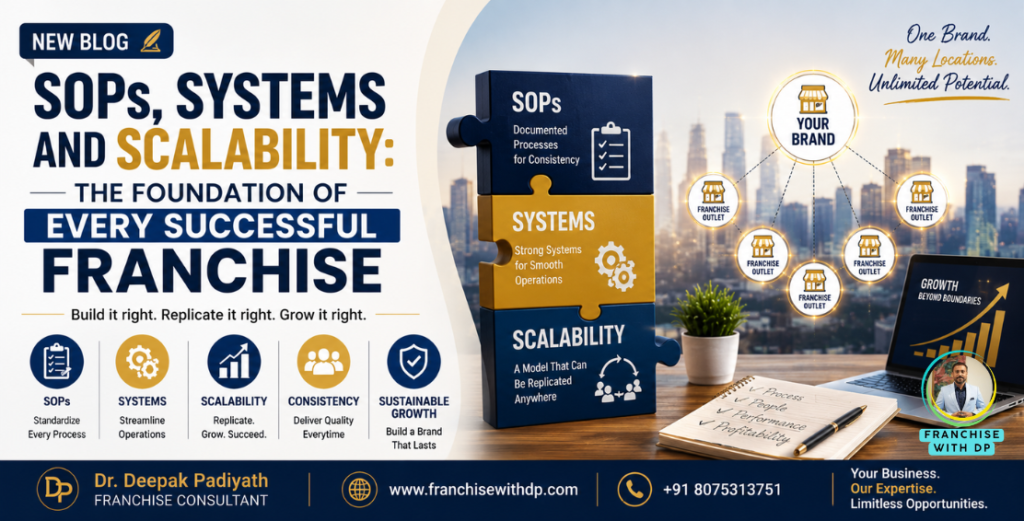
This is where SOPs, systems and scalability become the foundation of a franchise-ready business.
1. SOPs: Turning Your Experience into a Process
A business owner may know exactly how everything should be done.
But a franchisee doesn’t have the owner’s years of experience.
Your knowledge needs to be converted into Standard Operating Procedures (SOPs).
For example, if you run a successful training centre, your SOPs could cover:
- How enquiries are handled
- How students are counselled
- How admissions are processed
- How trainers are selected
- How classes are conducted
- How feedback is collected
- How marketing activities are planned
The goal is simple:
Someone else should be able to follow your process and deliver a similar customer experience.
2. Systems: Making the Business Less Dependent on the Owner
A franchise business cannot depend entirely on the founder’s personal involvement.
Imagine a restaurant where only the owner knows the recipes, suppliers and customer preferences.
Can that business operate successfully if the owner opens five more outlets?
Probably not.
A franchise-ready business needs systems for:
Sales → Operations → Finance → HR → Marketing → Customer Service → Reporting
When these systems are documented and integrated, the business becomes easier to replicate.
3. Scalability: Can You Repeat the Success?
A business can be profitable without being scalable.
That’s an important distinction.
For example, a business may perform exceptionally well because the owner personally manages every customer, employee and supplier.
But if opening the second location requires the owner’s presence all over again, scaling becomes difficult.
A scalable franchise should allow the owner to replicate:
Business Model + Brand + Processes + Customer Experience
across different locations.
A Simple Example
Consider a successful coaching centre.
Before franchising:
The owner personally handles counselling, faculty selection, marketing and student complaints.
After systemisation:
The franchise receives:
- Operations manual
- Marketing guidelines
- Staff recruitment process
- Training programme
- Counselling scripts
- Reporting formats
- Technology systems
- Brand guidelines
Now the franchisee doesn’t have to reinvent the business.
They have a roadmap to follow.
That’s the real power of franchising.
What Makes a Business Franchise-Ready?
Before offering franchises, ask yourself:
Can my business be replicated?
Can a new person learn the business without depending on me?
Are my processes documented?
Can quality be maintained across multiple locations?
Can I support franchisees after they launch?
If the answer to most of these questions is “No”, the business may need some preparation before franchising.
And that’s perfectly normal.
Franchise readiness is something that can be built.
Franchising Is More Than Selling Your Brand
One of the biggest mistakes business owners make is thinking:
“I have a successful business, so I can sell franchises.”
A franchise is not simply the right to use your brand name.
You are actually transferring a business system.
The franchisee is investing not only in your brand but also in your:
- Knowledge
- Processes
- Systems
- Training
- Support
- Business model
That’s why developing a proper franchise structure is critical before approaching investors.
The Ultimate Test
Here’s a simple test for franchise readiness:
If you can step away from your business for a month and it continues to operate successfully, you are moving closer to becoming franchise-ready.
If everything stops when the owner leaves, the first step may not be franchising.
It may be systemisation.
Once the business becomes system-driven rather than owner-dependent, expansion becomes much easier.
Conclusion
A successful business is not automatically a successful franchise.
To franchise successfully, you need to transform your experience into systems, systems into SOPs, and SOPs into a scalable business model.
That’s what allows a business to move from:
One successful location → Multiple successful franchise locations.
If you’re considering franchising your business, the right preparation can help you build a franchise model that attracts investors and supports sustainable expansion.
About Dr. Deepak Padiyath
Dr. Deepak Padiyath is a Franchise Consultant who helps businesses evaluate their franchise potential, develop expansion strategies and connect with suitable franchise investors.
Website: Franchise With DP
Call / WhatsApp: +91 8075313751
If you’re wondering “Is my business ready to franchise?”, getting an expert assessment before approaching franchise investors can save considerable time, money and effort.